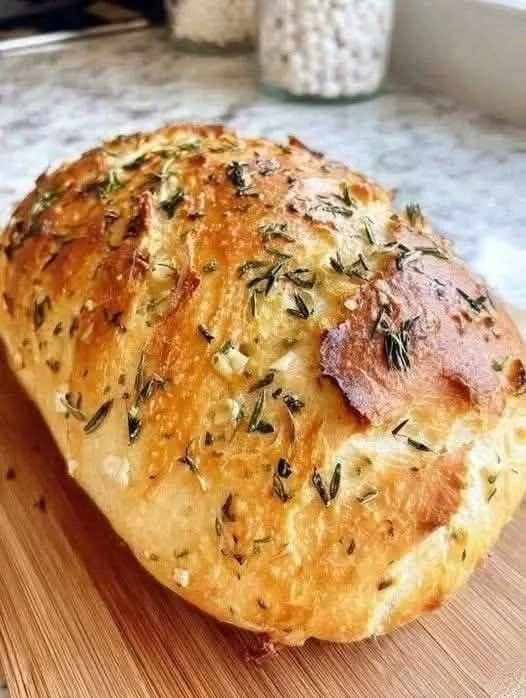
This Classic Homemade Bread skips artificial preservatives and complex artisanal techniques, delivering a soft crumb and golden crust using basic pantry staples. Perfect for morning toast, sandwiches, or family dinners, this wholesome loaf comes together in about an hour.
Ingredients & Equipment
Equipment Required
-
Large, wide mixing bowl
-
Measuring scale & cups
-
Whisk & pastry brush
-
Loaf pan (or baking sheet)
-
Wire cooling rack
Component Breakdown
| Section | Ingredient | Quantity | Functional & Culinary Role |
| Primary Starch | All-purpose flour | 720g (6 cups) | Forms primary starch framework and viscoelastic gluten matrix. |
| Fermentation Catalyst | Active dry yeast | 10g (1 packet) | Microbial leavener; ferments sugars to excrete $CO_2$ gas. |
| Hydration Base | Warm water | 200 ml (~3/8°C–43°C) | Hydrates yeast and proteins to initiate gluten building. |
| Starter Reserved Flour | All-purpose flour | 120g (1 cup) | Reserved for initial liquid yeast activation paste. |
| Gluten Regulator | Fine salt | 10g (1 tsp) | Controls yeast fermentation speed and tightens gluten strands. |
| Glaze Wash | Egg yolk | 1 piece | Drives deep, glossy Maillard browning on top crust. |
| Glaze Diluent | Whole milk | 1 tbsp | Thins egg wash for smooth, even brush application. |
🧪 Food Science: Microbial Fermentation & Gluten Development
-
Thermal Yeast Hydration Limits: Active dry yeast requires lukewarm water between $100^\circ\text{F}$ and $110^\circ\text{F}$ ($38^\circ\text{C}\text{–}43^\circ\text{C}$). Water below $90^\circ\text{F}$ leaves yeast dormant, while temperatures exceeding $120^\circ\text{F}$ ($49^\circ\text{C}$) thermal-denature the living fungal enzymes, preventing dough rise.
-
Viscoelastic Gluten Alignment: Mechanical kneading hydrates and aligns insoluble wheat proteins (gliadin and glutenin) into a viscoelastic matrix. This protein web traps expanding carbon dioxide bubbles during proofing and early baking (“oven spring”).
-
Maillard Crust Glaze: Brushing the upper dough face with an egg yolk and milk wash introduces surface proteins and lipids. Under $375^\circ\text{F}$ oven heat, these molecules undergo a Maillard browning reaction, creating a glossy, golden-mahogany crust that traps internal moisture.
Step-by-Step Instructions:
LOOK NEXT PAGE DEAR──►
For Complete Cooking STEPS Please Head On Over To Next Page Or Open button (>)